Homeownership remains a dream for many Nigerians. Despite the booming real estate market and an increasing number of housing developments across the country, millions still find it difficult to own a home. But why is this the case—and more importantly, how can low-income earners still tap into property investment?

Challenges to Homeownership in Nigeria
- High Cost of Land and Housing
The prices of land and housing units in urban areas such as Lagos, Abuja, and Port Harcourt are often beyond the reach of average Nigerians. Even modest homes can cost millions of naira, creating a significant financial barrier. - Limited Access to Mortgage Financing
Nigeria’s mortgage system is underdeveloped. Most banks require large down payments (20–30%) and offer short repayment terms with high interest rates, making it nearly impossible for low-income earners to access home loans. - Inflation and Economic Instability
The naira’s declining value and rising inflation continue to erode savings. What might be affordable today could become unaffordable in a few months, making long-term saving for homeownership difficult. - Land Title and Documentation Issues
Many properties in Nigeria have unclear or disputed titles, making land acquisition risky and time-consuming, especially for first-time or small-scale investors.
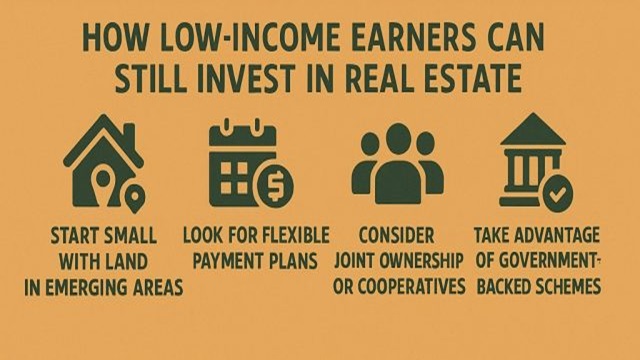
How Low-Income Earners Can Still Invest in Real Estate
Despite the challenges, real estate investment is not only for the wealthy. Here are ways low-income earners can still get involved:
- Start Small with Land in Emerging Areas
Properties in outskirts or developing areas (e.g., Mowe, Ibeju-Lekki, Mowe-Ofada, Murewa) are much more affordable and often appreciate quickly as infrastructure improves. Investing in such locations offers a gateway into the property market. - Look for Flexible Payment Plans
Many reputable real estate companies offer flexible payment plans — some as low as ₦10,000 monthly. These allow buyers to pay over time without needing to secure a loan. - Consider Joint Ownership or Cooperatives
Partnering with family, friends, or co-operative societies makes it easier to pool resources and invest together, reducing individual financial burdens. - Invest in Real Estate Crowdfunding or REITs
For those not ready to buy land outright, real estate investment trusts (REITs) and crowdfunding platforms offer a way to invest smaller amounts and earn returns. - Take Advantage of Government-Backed Schemes
Initiatives like the National Housing Fund (NHF) and state-supported housing programs can help provide subsidized access to housing for eligible Nigerians.
Conclusion
Owning a home in Nigeria is not easy — but it is possible. By shifting focus from instant luxury to strategic long-term investments, low-income earners can gradually build wealth through real estate. The key is starting with what you can afford today and growing from there. With patience, the dream of owning a home can become a reality.